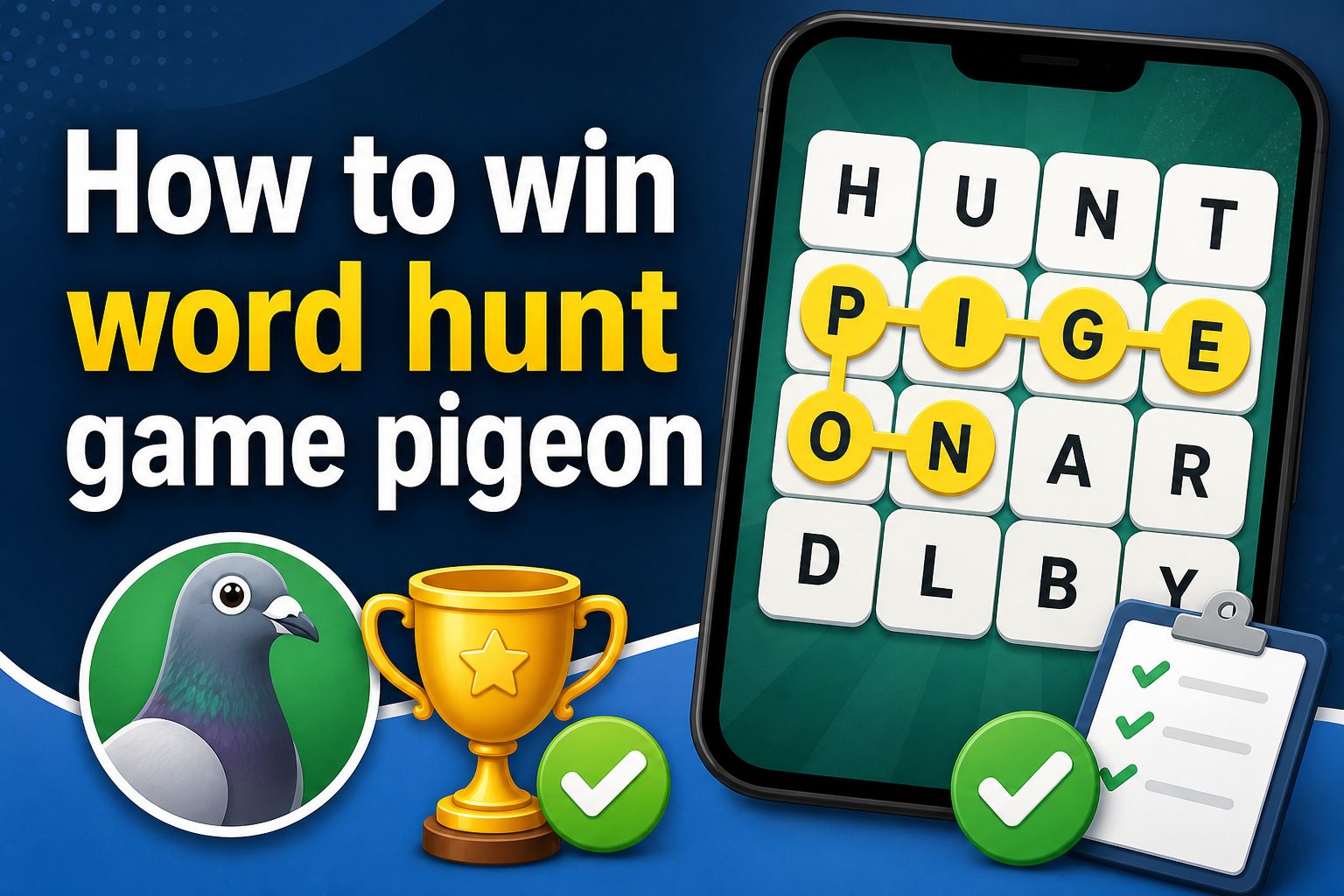
How to win Word Hunt Game Pigeon starts with learning how the game really rewards speed, pattern recognition, and smart word choices. Word Hunt looks simple: you swipe letters on a small board to make as many words as possible before time runs out. But winning consistently takes more than random swiping. You need a strategy for spotting common word patterns, building longer words, using prefixes and suffixes, and staying calm under pressure. This guide explains how Word Hunt works, why some players score higher than others, and what practical habits can help you improve. You will also find word-finding techniques, practice ideas, common mistakes, expert tips, and answers to frequent questions.
What Word Hunt Game Pigeon Is
Word Hunt is a word puzzle game inside Game Pigeon, the iMessage game collection used on iPhones and iPads. Players take turns finding words on a letter grid by connecting adjacent letters. Letters can usually be connected horizontally, vertically, or diagonally, as long as each next letter touches the previous one.
The goal is simple: find more valid words and earn more points than your opponent. Short words help build your score, but longer words are usually more valuable. A strong player does both. They quickly collect easy words while also looking for longer, higher-scoring combinations.
Word Hunt is popular because it is quick, competitive, and easy to play with friends. A round only takes a short amount of time, but every second matters. That makes it a mix of vocabulary, focus, hand speed, and puzzle-solving.
Why Strategy Matters In Word Hunt
Many beginners think Word Hunt is only about having a big vocabulary. Vocabulary helps, but it is not the whole game. A player with a smaller vocabulary can still beat someone who knows more words if they scan the board better and waste less time.
Strategy matters because the timer creates pressure. If you spend too long hunting for one impressive word, you may miss ten smaller words that were easy to score. Good players know when to chase long words and when to move quickly through common patterns.
A strong strategy also helps you avoid panic. When the board looks messy, experienced players rely on systems. They check common endings, try plural forms, reverse directions, and look for familiar letter clusters. This gives them a repeatable way to score instead of depending on luck.
How Word Hunt Scoring Works
Word Hunt rewards valid words, and longer words usually give more points than very short ones. The exact scoring can vary by version or settings, but the basic idea is consistent: more words and better words lead to a higher score.
Short words are useful because they are fast. Words like “cat,” “run,” “set,” “sun,” and “tin” may not be exciting, but they keep points moving. Longer words are useful because they create bigger score jumps. A word like “trainer,” “stone,” or “planet” can be worth much more than a simple three-letter word.
The best approach is balanced. Do not ignore small words, especially early in the round. They give you momentum and help you understand the board. Once you notice useful clusters, you can build longer words from the same area.
How To Scan The Board Faster
Fast scanning is one of the biggest skills in Word Hunt. Instead of staring at the entire grid at once, break it into smaller areas. Look at one corner, then one row, then one cluster of letters. Your brain will recognize patterns more easily when the board feels less crowded.
Start with common starting letters such as S, T, R, C, P, M, B, and D. These letters begin many English words, so they are useful anchors. Then check nearby vowels. Most words need vowels, so a consonant near A, E, I, O, or U often creates several possibilities.
You can also scan for letter pairs. Look for “th,” “sh,” “ch,” “st,” “tr,” “br,” “cl,” “ing,” “ed,” and “er.” These combinations appear often, and spotting them quickly can unlock several words from one section of the board.
Best Word Hunt Patterns To Look For
Some word patterns appear again and again in Word Hunt. Learning them helps you find words faster, even when the board is unfamiliar.
Common patterns include:
Short Starter Words:
Look for simple three-letter words first, such as “ate,” “bat,” “dog,” “run,” “sit,” “pen,” and “map.” These help you score quickly.
Plural Forms:
If you find “cat,” check whether you can make “cats.” If you find “tree,” look for “trees.” Adding S is one of the easiest ways to increase your score.
Past Tense Endings:
Words ending in “ed” are valuable. Try “played,” “moved,” “tested,” and similar patterns if the letters are available.
Common Endings:
Look for “er,” “ing,” “ly,” “est,” and “tion.” These endings can turn basic words into stronger ones.
Reversed Paths:
Sometimes a word appears backward or diagonally. If you see a familiar cluster, try moving through it in different directions.
Word Families:
When you find one word, look for related words nearby. “Play” may lead to “plays,” “played,” and “player.”
How To Build Longer Words
Longer words are where many Word Hunt games are won. The trick is to build them from smaller words instead of trying to see the whole word at once. If you find “rain,” check whether you can extend it to “rainy,” “rains,” or “rained.” If you find “mark,” look for “marks,” “marked,” or “marker.”
Prefixes and suffixes are especially useful. A prefix comes at the beginning of a word, while a suffix comes at the end. If the board has letters for “re,” “un,” “pre,” “ed,” “er,” “ing,” or “s,” you should pay attention. These small parts can create longer words quickly.
Do not spend the whole game chasing one long word. A good rule is to attempt a long word when you already see most of it. If you only have a vague idea, move on and collect easier points.
A Practical Step By Step Winning Method
Use this simple process when a round starts:
1. Scan For Vowels First
Quickly notice where the vowels are. Vowels connect consonants and make words possible. A cluster with two or three vowels is often a high-value area.
2. Find Easy Three Letter Words
Start with short words to build score and confidence. Do not dismiss them. Fast small words can decide a close match.
3. Add S Where Possible
Every time you find a noun or verb, check for an S nearby. Plurals and simple verb forms are quick extra points.
4. Look For Common Endings
Search for “ed,” “er,” “ing,” and “ly.” These endings often turn ordinary words into longer, higher-scoring words.
5. Reuse Strong Letter Clusters
If one section of the board gives you several words, stay there briefly. A productive cluster usually has more words hidden inside it.
6. Change Direction Often
Words can appear diagonally, backward, and in curved paths. If you only scan left to right, you will miss many options.
7. Save Wild Guesses For Later
Early in the round, focus on words you know. Near the end, quick guesses can sometimes help if you are running out of ideas.
8. Finish With Short Words
In the final seconds, stop overthinking. Swipe any valid short words you see. A few small points can win the round.
Useful Word Categories To Practice
Practicing by category helps you recognize words faster during real games. You do not need to memorize a dictionary. Focus on common groups that appear often.
Good categories to practice include:
Animals: cat, dog, rat, bird, bear, deer, fish, goat, horse, mouse.
Food Words: pie, tea, rice, soup, cake, bread, peach, apple, grape.
Action Words: run, sit, jump, play, move, read, sing, draw, make.
Nature Words: sun, rain, tree, leaf, rock, sand, wind, river.
People Words: man, woman, girl, boy, mom, dad, aunt, uncle.
Common Objects: pen, cup, bag, box, chair, phone, book, clock.
The point is not to list every possible word. The point is to train your eyes to recognize familiar patterns quickly. The more patterns you know, the less time you waste thinking.
Examples Of Strong Word Hunt Thinking
Imagine you see the letters C, A, T, S close together. A beginner may only find “cat.” A stronger player checks for “cats,” “act,” “acts,” “sat,” “cast,” and “scat.” One small cluster can produce several words.
If you see P, L, A, Y, E, R, and S, do not stop at “play.” Look for “plays,” “player,” “players,” “lay,” “lays,” “ear,” “ray,” and “real” if the paths work. Good Word Hunt players squeeze value from every strong area of the board.
If the board has T, H, E, R, E, you might find “the,” “her,” “here,” “there,” “tree,” and “three” depending on the letter positions. This is why common clusters matter. They help your brain move from one word to the next without starting over.
Best Practices For Winning More Often
Winning Word Hunt is about repeatable habits. You want to play in a way that produces reliable points, even when the board is not ideal.
Keep these best practices in mind:
Use Both Hands If Comfortable: Some players hold the phone with one hand and swipe with the other. Others place the phone down for better control. Use the setup that feels fastest and most accurate.
Do Not Chase Only Long Words: Long words are valuable, but missing many short words can cost you the game.
Practice Common Endings: Knowing “ed,” “er,” “ing,” “ly,” and “s” patterns can raise your score quickly.
Stay Loose Under Pressure: Panic makes you stare without seeing. Move your eyes and keep swiping.
Review Your Weaknesses: If you often miss plural words, practice adding S. If you miss diagonal words, force yourself to scan diagonally.
Play Regularly: Short, focused practice sessions are better than occasional long sessions.
Common Mistakes To Avoid
One common mistake is looking only for words that read left to right. Word Hunt boards are not standard sentences. Words can twist, turn, and move diagonally. If you train yourself to search in every direction, you will immediately find more options.
Another mistake is ignoring short words. Some players think short words are not worth it, but they add up. In a timed game, speed matters. A player who collects many quick words can beat a player who finds only a few long ones.
Many players also spend too long on one area. If a cluster stops producing words, move to another section. You can always come back later with fresh eyes.
A final mistake is swiping carelessly. Fast is good, but inaccurate swipes waste time. If the game rejects a word because your path was sloppy, you lose momentum. Smooth, controlled swipes are better than frantic ones.
Expert Tips For Higher Scores
Strong players often use a “base word” method. They find one simple word, then expand it in several directions. For example, “test” can become “tests,” “tested,” “tester,” or “testing” if the letters are available. This method is faster than searching for unrelated words one by one.
Another useful tip is to watch for rare letters. Letters like Q, X, Z, and J can create valuable words, but they can also waste time if no useful vowels are nearby. Check them quickly, but do not get stuck.
It also helps to learn small valid words. Words like “ore,” “ire,” “eel,” “tar,” “rot,” “tin,” “arc,” and “era” may not come up in daily conversation, but they are useful in word games. The more short words you know, the easier it becomes to fill dead time during a round.
How To Practice Word Hunt
The best way to practice is with intention. Do not just play round after round without noticing what happened. After each game, think about why you won or lost. Did you miss obvious plurals? Did you freeze at the start? Did you focus too much on long words?
You can also practice outside the app. Look at random letter grids or word puzzle boards and give yourself one minute to find as many words as possible. Write them down, then check for patterns you missed.
Another helpful drill is suffix practice. Pick a common ending like “ing” or “ed,” then try to think of as many words as possible that use it. This trains your brain to recognize word extensions quickly during live play.
Playing Against Friends
When playing friends, your goal is not only to score well but also to understand their style. Some opponents are fast with short words. Others are patient and hunt for longer words. If you know someone usually scores with many small words, you may need to be more aggressive early. If they rely on long words, steady scoring can keep you competitive.
Friendly competition also makes practice more enjoyable. You can challenge the same person several times and track what improves. Over time, you will notice that boards feel less random and your first few words come faster.
If you are playing casually, keep the game fun. Word Hunt is competitive, but it is still a quick social game. The best matches are close, fast, and playful.
Best Devices And Setup
Your setup can affect your performance more than you might expect. A clean screen helps your finger move smoothly. Good lighting helps you see letters quickly. A stable phone position can reduce mistakes.
Some players perform better when the phone is flat on a table. Others prefer holding it close. Try both and see which gives you better control. If your finger blocks letters while swiping, adjust your grip or use a lighter touch.
Turn off distractions when playing seriously. Notifications, background noise, and interruptions can break your focus. Since rounds are short, even a few seconds of distraction can change the result.
How To Make Word Hunt More Fun
Word Hunt is more enjoyable when you add small challenges or friendly rules. For example, you can play best of five rounds, loser chooses the next game, or only count wins by a certain margin. These simple variations make casual matches feel more interesting.
You can also create personal goals. Try to beat your previous score, find a seven-letter word, or focus on using more suffixes. These goals make practice feel useful even when you lose.
If you are playing with a group, compare the longest words found after each round. This can be fun because different players often spot completely different paths on the same board.
Frequently Asked Questions
What Is The Best Way To Win Word Hunt Game Pigeon?
The best way to win is to combine speed with pattern recognition. Start with easy short words, then build longer words from common prefixes, suffixes, and letter clusters. Do not stare at one area for too long. Keep scanning, use plural forms, and collect steady points throughout the round.
Are Long Words Better Than Short Words In Word Hunt?
Long words are usually worth more, but short words are still important. A winning score often comes from a mix of both. Short words help you score quickly, especially when time is running out, while longer words give you bigger point jumps when you can find them without wasting too much time.
How Can I Find Words Faster?
Practice scanning the board in sections instead of looking at everything at once. Search for vowels, common letter pairs, and endings like “ed,” “er,” “ing,” and “s.” When you find one word, immediately check whether it can become a plural, past tense word, or related longer word.
Does Vocabulary Matter In Word Hunt?
Vocabulary matters, but it is not the only skill. Many games are won by players who know common word patterns and swipe efficiently. Learning more short words, everyday nouns, verbs, and common endings will help you improve faster than trying to memorize rare words only.
Should I Guess Words In Word Hunt?
Guessing can help near the end of a round, but it should not be your main strategy. Random guesses waste time if they are too frequent. Focus first on words you recognize. In the final seconds, quick educated guesses based on common patterns can sometimes add useful extra points.
How Do I Stop Freezing During A Round?
Use a starting routine. First scan for vowels, then find short words, then look for plurals and endings. Having a routine gives your brain something clear to do when the timer starts. The more you practice this pattern, the less likely you are to freeze under pressure.
Can I Get Better Without Playing Every Day?
Yes, but regular short practice helps. Even ten minutes a few times a week can improve your speed and recognition. Focused practice is more useful than mindless play. Pay attention to the kinds of words you miss, then practice those patterns in future rounds.
Conclusion
Winning Word Hunt Game Pigeon comes down to more than fast fingers. The best players scan the board with purpose, recognize common word patterns, use short words wisely, and build longer words from strong letter clusters. With practice, the board starts to feel less random and more manageable.
If you want to improve, focus on simple habits first: find vowels, collect easy words, add plurals, look for endings, and keep moving. Over time, those small improvements will lead to higher scores, closer matches, and more consistent wins.